Lock 1 · Define
Problem Definition
How to find, narrow and evidence a problem worth three months of your team’s life — the single highest-leverage skill in the entire Foundry journey.
8 minute read · applies to Lock 1
Start from a person, not a technology
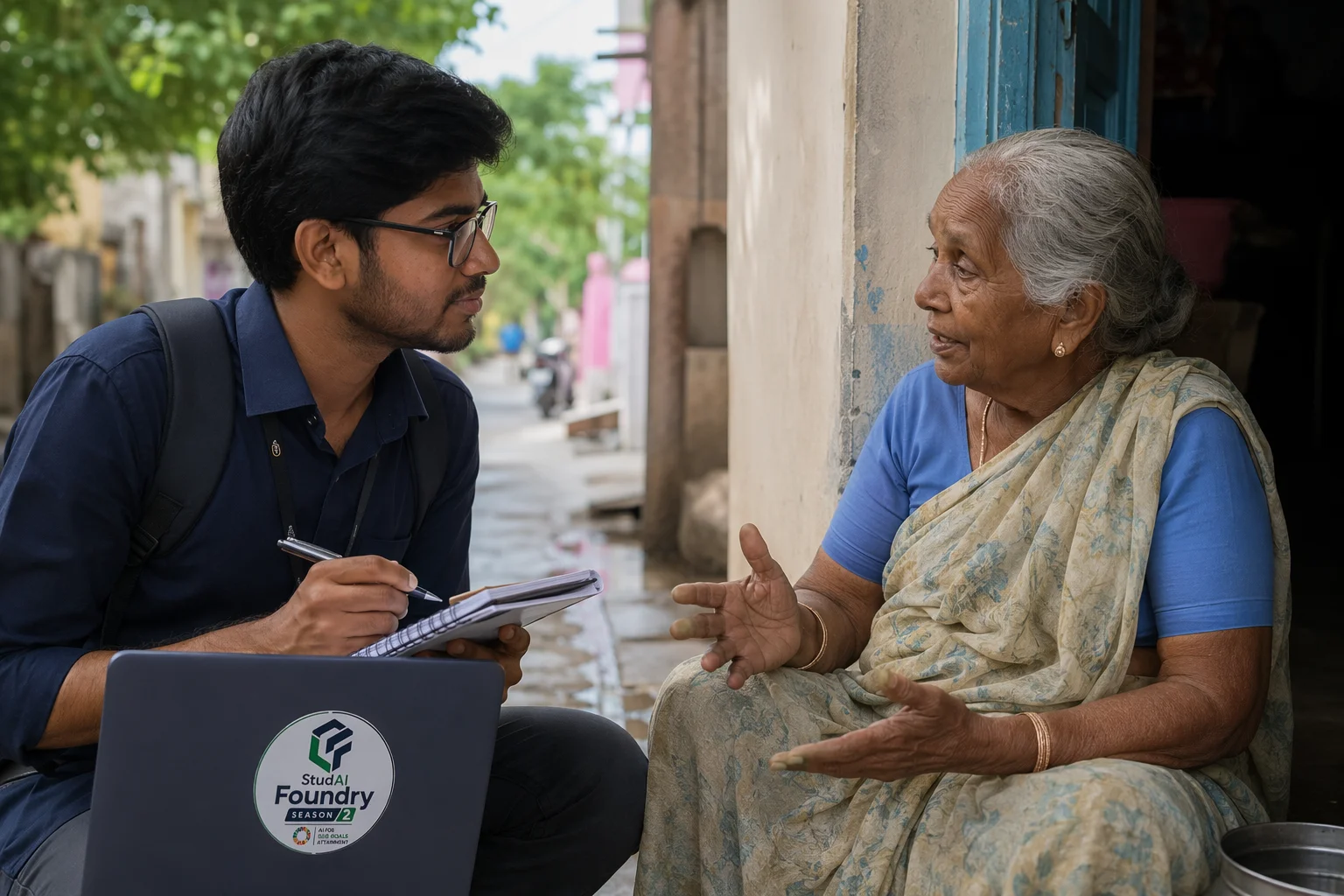
Weak submissions start with "we want to use LLMs" and hunt for a problem to attach. Strong submissions start with a specific person in a specific situation: a farmer deciding when to sell, a nurse tracking follow-ups on paper, a student who cannot parse an English-only form. The technology question comes later — and sometimes the honest answer is that AI is only part of the solution.
Write your problem statement as one sentence containing a person, a situation and a cost: "Smallholder farmers near Pollachi lose part of their tomato crop value because they cannot judge whether to sell today or store for a week." If you cannot fill in all three parts, you have a theme, not a problem.
Evidence beats opinion
Lock 1 scores evidence and user understanding explicitly. Talking to two real potential users — with notes — outweighs any number of statistics pasted from reports. Do both: primary conversations for depth, published data for scale.
- Interview at least two people who live the problem; record what surprised you
- Find one authoritative source that quantifies the problem’s scale — cite it precisely
- Document what people do today (the current workaround is your real competitor)
- Note what existing solutions exist and why they fall short for your users
Narrow until it hurts
"Improve healthcare with AI" is unbuildable. "Help ASHA workers in one block complete post-screening follow-ups" can be built, piloted and measured within the Foundry timeline. Narrowing feels like ambition-shrinking; it is actually what makes impact provable. You can always widen after you have one working wedge.
Map the SDG honestly
Choose the SDG your problem genuinely lives in — then read that goal’s targets and name the specific target your project advances. Evaluators can tell the difference between an SDG chosen first and one attached last. A genuine mapping also unlocks better datasets and impact metrics, because the SDG framework has both.
Define the AI opportunity precisely
Finish Lock 1 by answering: what specifically will AI do here that simpler software cannot? Acceptable answers involve pattern recognition, language understanding, prediction under uncertainty or scale of personalisation. If a lookup table or a form would solve the problem, say so and design AI where it genuinely adds power — meaningful use of AI carries 20 of Lock 1’s 100 points.
Before you submit — the checklist
- One-sentence problem statement with person, situation and cost
- Two or more documented user conversations
- One cited, authoritative scale statistic
- Current workaround and existing solutions mapped
- Specific SDG target named, not just a goal number
- A precise claim about what AI adds beyond simpler software
Related guides
Solution Blueprint
Turning a validated problem into a complete solution design: user journey, feature scope, and the decisions th...
Lock 2 · DesignData Planning
Finding data you can actually use, handling it lawfully, and being honest about its gaps — the part of the blu...
All LocksImpact Measurement
Turning "this could help people" into a number you can defend: choosing one honest metric, building a baseline...
Put this guide to work.
The rubric this guide addresses is waiting inside your team’s build journey.
View Season 2