Season 2 registrations are open — Chennai · 28 August 2026 and Coimbatore · 25 September 2026.

Register Your Team

Sustainable Development Goal 01 / 17

No Poverty

End poverty in all its forms, everywhere. For Foundry builders this means tools that help low-income households find support they are entitled to, protect fragile incomes and escape debt traps.
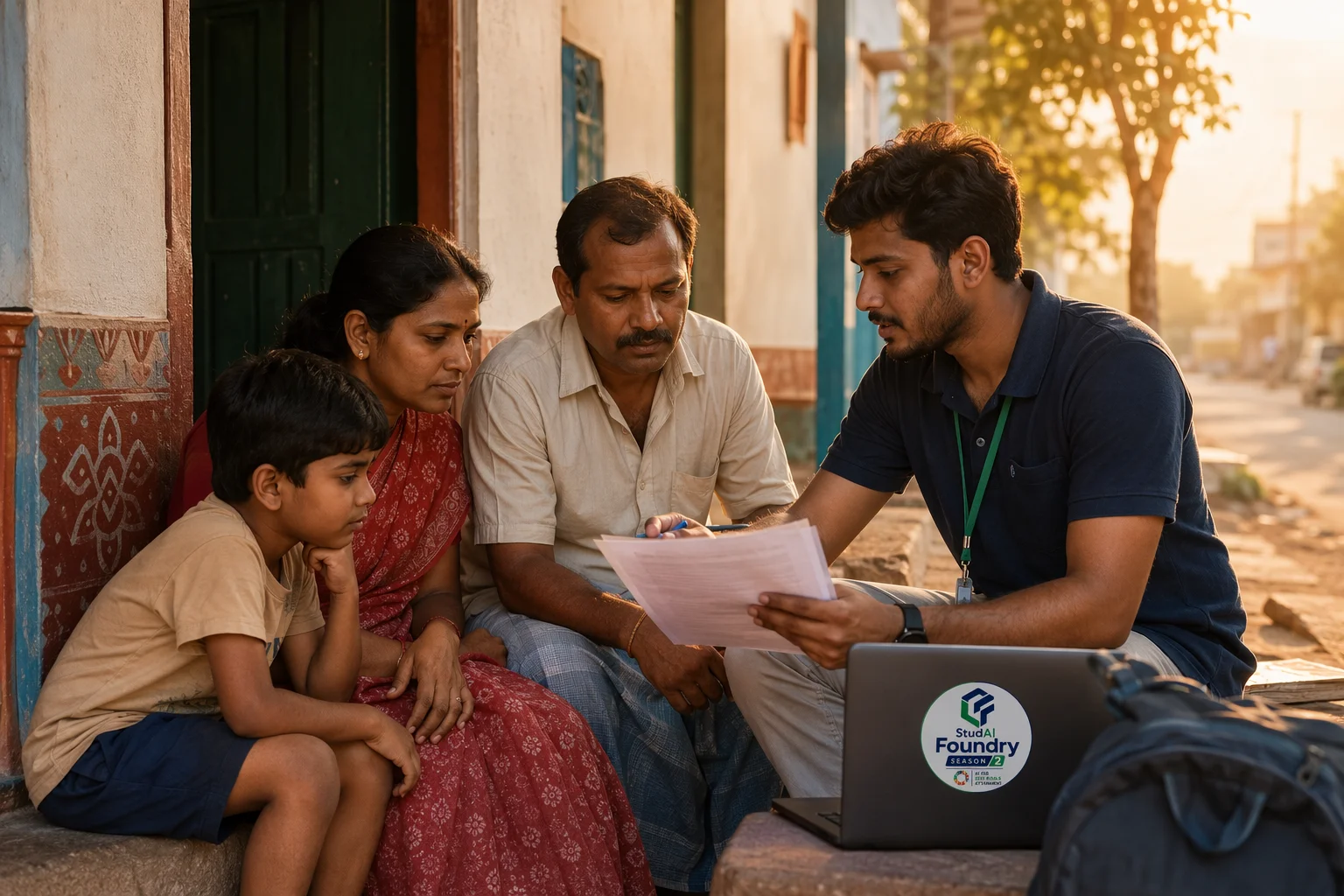
A community volunteer helping a family complete paperwork at their doorstep.

Why this goal matters

Poverty is rarely just a shortage of money. It is missed entitlements, predatory credit, unpredictable income and one medical emergency away from crisis. Most anti-poverty systems already exist — schemes, subsidies, insurance — but the people who need them most struggle to discover, understand and access them. Well-designed software can shrink that gap.

The Indian context

India runs some of the largest social-protection programmes in the world, spanning food security, rural employment guarantees, pensions and housing support. Discovery and last-mile access remain the hard problems: eligibility rules are complex, documentation requirements are confusing, and awareness is lowest exactly where need is highest.

Tamil Nadu, specifically

Tamil Nadu has a strong welfare-delivery tradition — from the public distribution system to noon-meal schemes — yet urban informal workers in Chennai and Coimbatore, and small farming households in surrounding districts, still report difficulty matching themselves to the right schemes and completing applications correctly the first time.

People and communities affected

  • Informal and gig workers with irregular income
  • Landless agricultural labour households
  • Urban families in unauthorised settlements
  • Elderly people living alone without digital access
  • Households recovering from a medical or climate shock

Key challenge areas

  • Benefit-scheme discovery and eligibility matching
  • Application assistance and document preparation
  • Debt-cycle and predatory-lending awareness
  • Income smoothing for irregular earners
  • Shock detection and early support routing

The AI Lens

Where AI belongs here — and where it does not.

Where AI can meaningfully help

  • Matching a household profile against complex, changing eligibility rules in plain language
  • Conversational guidance in Tamil and other local languages for application steps
  • Summarising scheme documents into checklists a first-time applicant can follow
  • Flagging households at risk of falling into debt from patterns they choose to share

Where AI may be inappropriate

  • Automatically deciding who deserves or does not deserve support — eligibility decisions belong to accountable institutions
  • Scoring or ranking poor households in ways that could stigmatise or exclude them
  • Collecting sensitive financial data without a clear, consented purpose

Build Directions

Example problem directions

Starting points, not prescriptions — the strongest submissions narrow one of these into a specific, evidenced local problem.

Direction 01

A scheme-discovery assistant that turns a short household conversation into a ranked list of likely entitlements with document checklists

Direction 02

A first-time-applicant companion that explains rejections and exactly what to fix

Direction 03

An income-planning tool for gig workers that anticipates lean weeks

Direction 04

A community-worker dashboard that helps one volunteer support many households accurately

Potential users

  • Households seeking entitlements
  • Community volunteers and self-help groups
  • Panchayat and ward-level officials
  • NGO field workers

Possible datasets

  • Publicly documented central and state scheme rules and guidelines
  • Open government data portals (data.gov.in) for programme coverage
  • Census and NFHS summary indicators (aggregate, public)
  • Your own consented user research and pilot interviews

Data-access limitations

  • Individual beneficiary records are private and must never be scraped or guessed
  • Scheme rules change; a static snapshot goes stale quickly
  • Aggregate indicators hide huge district-level variation

Privacy, bias and safety risks

  • Wrong eligibility guidance can cause real families to miss support — accuracy and human fallback matter
  • Language models can hallucinate scheme names or amounts; every claim needs a verifiable source
  • Collecting income data creates privacy exposure for already-vulnerable people

Responsible-AI considerations

  • Cite the official source for every scheme fact your system states
  • Design a human escalation path for uncertain cases
  • Store the minimum personal data possible; prefer on-device or session-only processing
  • Test with low-literacy and non-English users before claiming usability

Suggested impact metrics

  • Number of successful scheme applications assisted (verified in pilot)
  • Time from need to correct application, before versus after
  • Accuracy of eligibility matches audited against official rules

Build for No Poverty.

Anchor your team in this goal, define one real problem, and start the three-lock journey.

Register Your Team