Season 2 registrations are open — Chennai · 28 August 2026 and Coimbatore · 25 September 2026.

Register Your Team

Sustainable Development Goal 10 / 17

Reduced Inequalities

Reduce inequality within and among countries. For builders: tools that remove access barriers — language, disability, geography, documentation — between people and the systems meant to serve them.
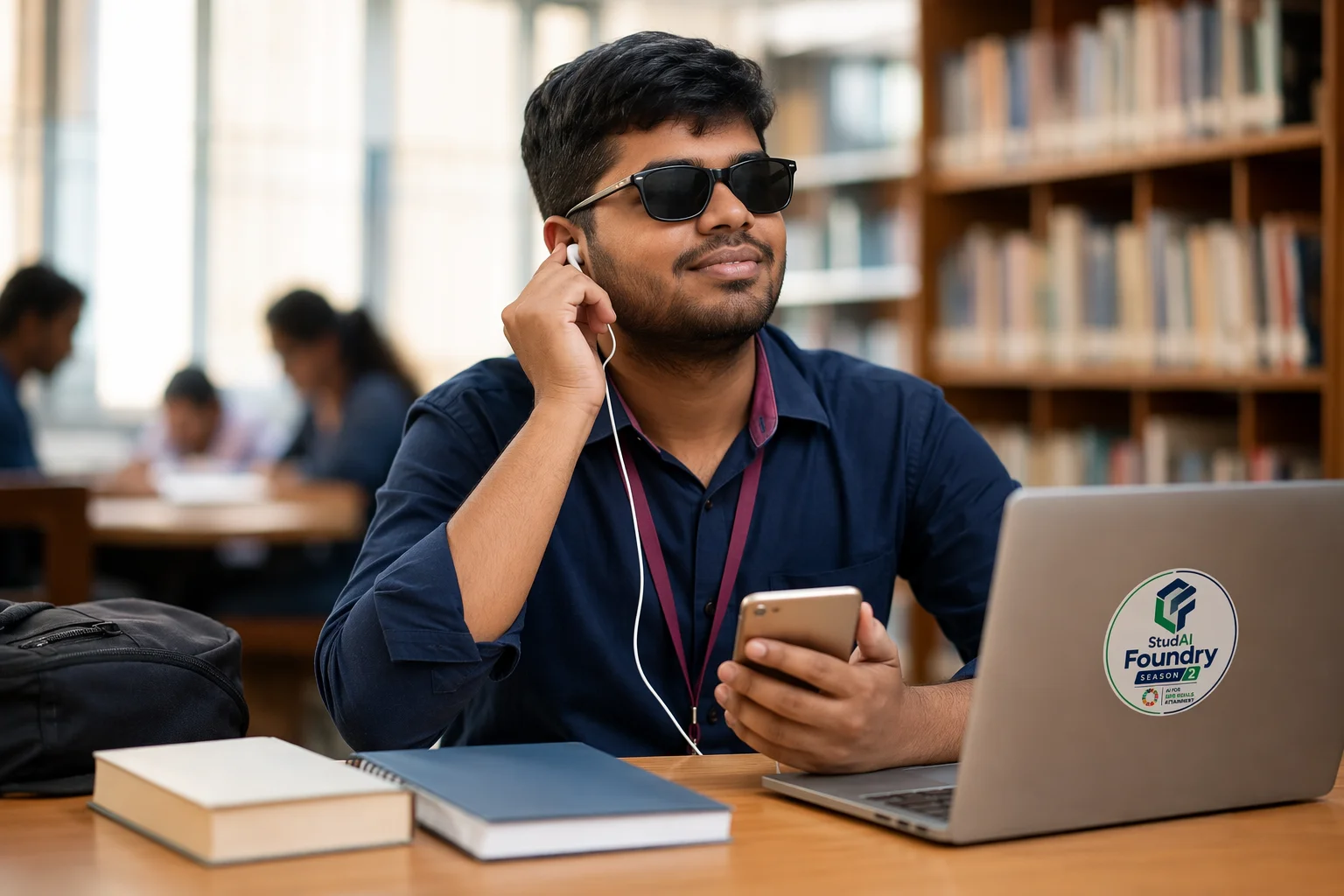
A blind student using a phone with headphones to read a document independently.

Why this goal matters

Inequality is often experienced as friction: the form only in English, the office only in the city, the interface only for the sighted, the opportunity only for those with connections. Each barrier is small to the system and enormous to the person. Software that removes specific frictions for specific excluded groups produces some of the most direct impact in this entire goal set.

The Indian context

India’s diversity means inclusion problems are never abstract: twenty-two scheduled languages, millions of persons with disabilities, deep urban-rural digital divides and first-generation everything — students, bank customers, internet users. Accessibility law (RPWD Act 2016) sets real obligations that most digital services still fail to meet.

Tamil Nadu, specifically

Tamil Nadu’s strong services economy raises the cost of exclusion: government services, banking and education are increasingly digital-first, which either includes or excludes at scale. Tamil-first design, disability access and migrant-worker inclusion (a large Hindi- and Odia-speaking workforce in local industry) are concrete local frontiers.

People and communities affected

  • Persons with visual, hearing, motor or cognitive disabilities
  • Non-English speakers navigating English-first systems
  • Migrant workers outside their home-language state
  • Elderly people facing digital-first services
  • Rural users on low-end devices and patchy networks

Key challenge areas

  • Digital accessibility retrofitting
  • Language access for public services
  • Assistive communication tools
  • Inclusive financial and government service access
  • Bias detection in automated decisions

The AI Lens

Where AI belongs here — and where it does not.

Where AI can meaningfully help

  • Real-time speech-to-text and sign-language-aware interfaces for deaf users
  • Reading and explaining documents aloud for blind and low-literacy users
  • Translating government and banking interactions across Indian languages
  • Auditing services for accessibility failures automatically at scale

Where AI may be inappropriate

  • Deciding disability entitlements or classifications
  • Face- or accent-based demographic inference
  • "Fixing" a person rather than the barrier — assistive design starts from user agency

Build Directions

Example problem directions

Starting points, not prescriptions — the strongest submissions narrow one of these into a specific, evidenced local problem.

Direction 01

A document-explainer for blind users: photograph any letter or form, hear structure-aware navigation, ask questions about it

Direction 02

A live transcription and vocabulary companion tuned for Indian classroom and clinic acoustics

Direction 03

A migrant-worker services bridge translating local processes into the worker’s language, end to end

Direction 04

An accessibility auditor that crawls a public site and produces a prioritised, developer-ready fix list

Potential users

  • Persons with disabilities and their organisations
  • Migrant-worker communities
  • Government service departments
  • Banks and utilities seeking compliance

Possible datasets

  • Open speech corpora for Indian languages (e.g. AI4Bharat resources)
  • WCAG and GIGW accessibility standards as evaluation ground truth
  • Public service-process documentation for grounded guidance
  • Co-designed pilot recordings with consenting users

Data-access limitations

  • Indian-language and Indian-accent training data remains thinner than English — measure your real error rates
  • Disability communities are heterogeneous; one pilot group does not represent all users
  • Sign-language datasets for Indian Sign Language are limited and dialect-varied

Privacy, bias and safety risks

  • Assistive tools that fail intermittently can strand users mid-task — reliability is an accessibility feature
  • Mistranslation of official content can cause legal and financial harm
  • Building "for" instead of "with" the community produces unusable tools

Responsible-AI considerations

  • Co-design and test with the actual user community; document it
  • Publish error rates per language and context honestly
  • Follow WCAG 2.1 AA in your own product — an inaccessible accessibility tool is a contradiction

Suggested impact metrics

  • Task-completion rate for target users on real tasks, before versus after
  • Word-error rate or translation accuracy on your local test set
  • Number of accessibility barriers removed and verified in pilot services

Build for Reduced Inequalities.

Anchor your team in this goal, define one real problem, and start the three-lock journey.

Register Your Team