Season 2 registrations are open — Chennai · 28 August 2026 and Coimbatore · 25 September 2026.

Register Your Team

Sustainable Development Goal 05 / 17

Gender Equality

Achieve gender equality and empower all women and girls. For builders: safety, economic participation and access tools designed with — not merely for — the women who will use them.
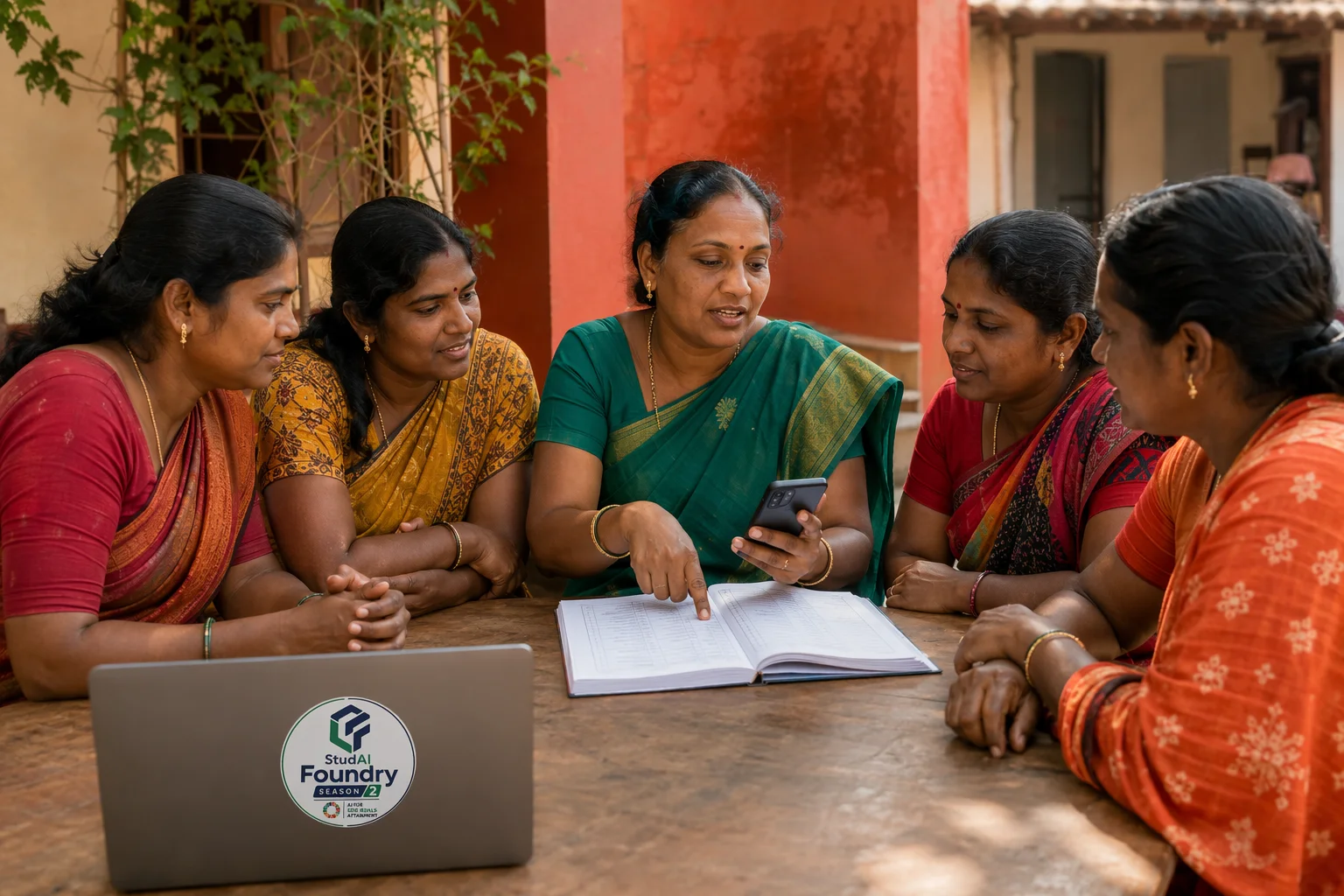
Women of a self-help group running their accounts on a shared phone.

Why this goal matters

Gender inequality shows up as interrupted education, unsafe commutes, unpaid care burdens, missing financial access and under-reported violence. Technology can widen access and lower reporting barriers, but badly designed technology also amplifies harassment and surveillance. The design bar here is higher, and that is exactly why serious builders should take it on.

The Indian context

India’s female labour-force participation remains low relative to its economy, and safety concerns measurably constrain women’s mobility, education and job choices. At the same time, women-led self-help groups form one of the world’s largest grassroots financial networks — a real institutional fabric technology can strengthen.

Tamil Nadu, specifically

Tamil Nadu has strong female education indicators and a deep self-help-group movement, alongside a large female industrial workforce in textiles and electronics around Coimbatore and Chennai. Safe commuting, hostel-to-factory logistics, grievance channels and financial independence are live, specific problem spaces.

People and communities affected

  • Women in industrial and gig workforces
  • Students navigating unsafe commutes
  • Self-help-group members running micro-enterprises
  • Survivors seeking support without exposure
  • Care-givers balancing unpaid work and employment

Key challenge areas

  • Safe mobility and trusted-network alerts
  • Discreet reporting and support-service navigation
  • SHG enterprise tooling and market access
  • Bias detection in hiring and opportunity access
  • Care-work coordination and time poverty

The AI Lens

Where AI belongs here — and where it does not.

Where AI can meaningfully help

  • Routing a support seeker to the right verified service in one conversation, in her language
  • Summarising legal rights and complaint procedures into actionable steps
  • Book-keeping and pricing assistance for SHG micro-enterprises
  • Auditing job descriptions and shortlists for biased language and patterns

Where AI may be inappropriate

  • Tracking women’s location “for safety” without their control — protection must not become surveillance
  • Predicting who is “likely” to be a victim; profiling causes harm
  • Automated moderation as the only response to gender-based abuse reports

Build Directions

Example problem directions

Starting points, not prescriptions — the strongest submissions narrow one of these into a specific, evidenced local problem.

Direction 01

A discreet support navigator: describe a situation, get verified helplines, legal options and nearest services, with a fast-exit design

Direction 02

An SHG business copilot: inventory, pricing, simple accounts and government-scheme matching in Tamil

Direction 03

A commute-companion built on user-controlled trusted circles rather than central tracking

Direction 04

A workplace-grievance assistant that helps document incidents accurately and privately

Potential users

  • Women workers and students
  • Self-help groups and federations
  • NGO support services
  • HR and compliance teams

Possible datasets

  • Published directories of verified helplines and one-stop centres
  • Public legal texts (POSH Act, DV Act) for grounded guidance
  • NCRB and NFHS aggregate indicators (public, aggregate only)
  • Consented co-design sessions with the actual user community

Data-access limitations

  • Survivor data must never be centrally warehoused by a student project — design for zero-knowledge where possible
  • Reported-crime data drastically undercounts reality; treat it as a floor, not a measure
  • Helpline directories go stale; verification workflows matter

Privacy, bias and safety risks

  • A safety app that fails silently is worse than none — failure modes must be explicit
  • Data leaks here endanger users physically, not just digitally
  • Tools designed without women in the room reliably miss the actual threat model

Responsible-AI considerations

  • Co-design with the user community; document that process in your submissions
  • Fast-exit, disguised-mode and local-only storage patterns for sensitive tools
  • No location sharing without granular, revocable, user-visible control
  • Escalation to human support services, tested end to end

Suggested impact metrics

  • Successful connections to verified services in a pilot
  • Task completion by first-time users under a realistic threat model
  • SHG revenue or time-saved deltas in a small measured cohort

Build for Gender Equality.

Anchor your team in this goal, define one real problem, and start the three-lock journey.

Register Your Team