Season 2 registrations are open — Chennai · 28 August 2026 and Coimbatore · 25 September 2026.

Register Your Team

Sustainable Development Goal 06 / 17

Clean Water and Sanitation

Ensure availability and sustainable management of water and sanitation for all. For builders: tools that make water quality visible, distribution fair and sanitation systems maintainable.
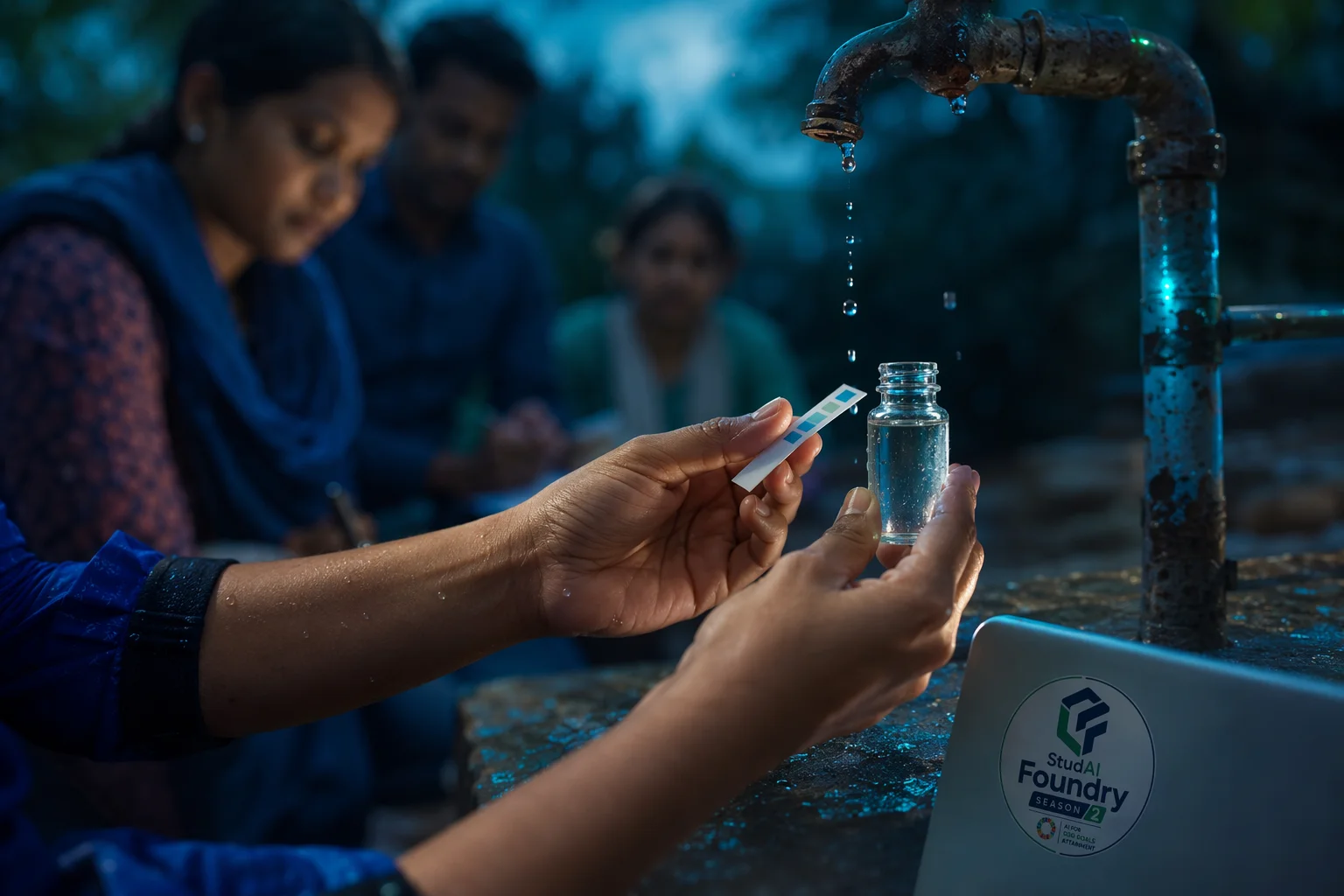
A resident testing water from a community tap with a field kit.

Why this goal matters

Water problems are visibility problems. Contamination is invisible until people fall sick; leaks are invisible until supply fails; groundwater depletion is invisible until wells run dry. Systems that measure, predict and communicate water reality give communities and utilities time to act.

The Indian context

India supports a sixth of the world’s population on a twenty-fifth of its freshwater. The Jal Jeevan Mission has expanded piped connections dramatically, shifting the challenge from access to reliability and quality. Urban utilities lose a large share of treated water to leaks and unauthorised connections; rural sources face fluoride, arsenic and bacterial contamination.

Tamil Nadu, specifically

Chennai’s 2019 “Day Zero” made urban water stress national news, and the city now runs one of India’s larger desalination and lake-restoration programmes. Coimbatore depends on the Siruvani and Pilloor systems with chronic tail-end distribution complaints. Across the state, tank (eri) restoration is a living civic movement that data tools can strengthen.

People and communities affected

  • Households on intermittent or tanker-dependent supply
  • Residents near polluted waterways and industrial clusters
  • Farmers sharing stressed groundwater aquifers
  • Sanitation workers facing unsafe conditions
  • Schools and health centres with unreliable water

Key challenge areas

  • Water-quality monitoring and alerting
  • Distribution fairness and leak detection
  • Groundwater stewardship for shared aquifers
  • Sanitation-infrastructure maintenance tracking
  • Community tank and lake restoration support

The AI Lens

Where AI belongs here — and where it does not.

Where AI can meaningfully help

  • Anomaly detection on supply and pressure data to find leaks and unfair distribution
  • Low-cost test-strip photo analysis for community water-quality reporting
  • Forecasting supply stress from rainfall, storage and consumption signals
  • Prioritising sanitation maintenance from complaint and inspection patterns

Where AI may be inappropriate

  • Declaring water “safe to drink” from a model alone — certification needs laboratory validation
  • Punitive individual consumption surveillance
  • Replacing the human decisions in inter-community water allocation disputes

Build Directions

Example problem directions

Starting points, not prescriptions — the strongest submissions narrow one of these into a specific, evidenced local problem.

Direction 01

A community water-quality journal: photograph field test kits, aggregate anonymised results on a ward map, alert when patterns shift

Direction 02

A utility assistant that flags probable leak zones from complaint clusters and supply telemetry

Direction 03

A tank-restoration companion for volunteer groups: baseline photos, silt tracking, seasonal comparison

Direction 04

A school water-safety dashboard covering testing schedules and follow-through

Potential users

  • Residents’ welfare associations
  • Water utilities and local bodies
  • Tank-restoration volunteer groups
  • School and PHC administrators

Possible datasets

  • Central Ground Water Board and state PWD published data
  • CPCB/TNPCB water-quality monitoring publications
  • IMD rainfall data (public)
  • Community-collected test results from your pilot, with consent

Data-access limitations

  • Official quality data is sparse in time and space; your pilot may need to generate its own
  • Utility telemetry is rarely open — partner early or design around complaint data
  • Sensor and test-strip readings need calibration discipline to be comparable

Privacy, bias and safety risks

  • False “safe” signals endanger health; false “unsafe” signals cause panic — communicate uncertainty honestly
  • Naming specific wells or homes can stigmatise; aggregate carefully
  • Hardware-dependent projects stall — have a data path that works without custom sensors

Responsible-AI considerations

  • Pair every quality claim with its testing method and confidence
  • Design alerts with local authorities, not around them
  • Open your aggregated data where consent allows, so communities own the picture

Suggested impact metrics

  • Detection lead time for supply or quality incidents in pilot data
  • Coverage: share of a ward’s sources with recent readings
  • Verified maintenance actions triggered by the tool

Build for Clean Water and Sanitation.

Anchor your team in this goal, define one real problem, and start the three-lock journey.

Register Your Team