Season 2 registrations are open — Chennai · 28 August 2026 and Coimbatore · 25 September 2026.

Register Your Team

Sustainable Development Goal 03 / 17

Good Health and Well-being

Ensure healthy lives and promote well-being for all at all ages. For builders: tools that widen access to screening, guidance and mental-health support — while never pretending to be a doctor.
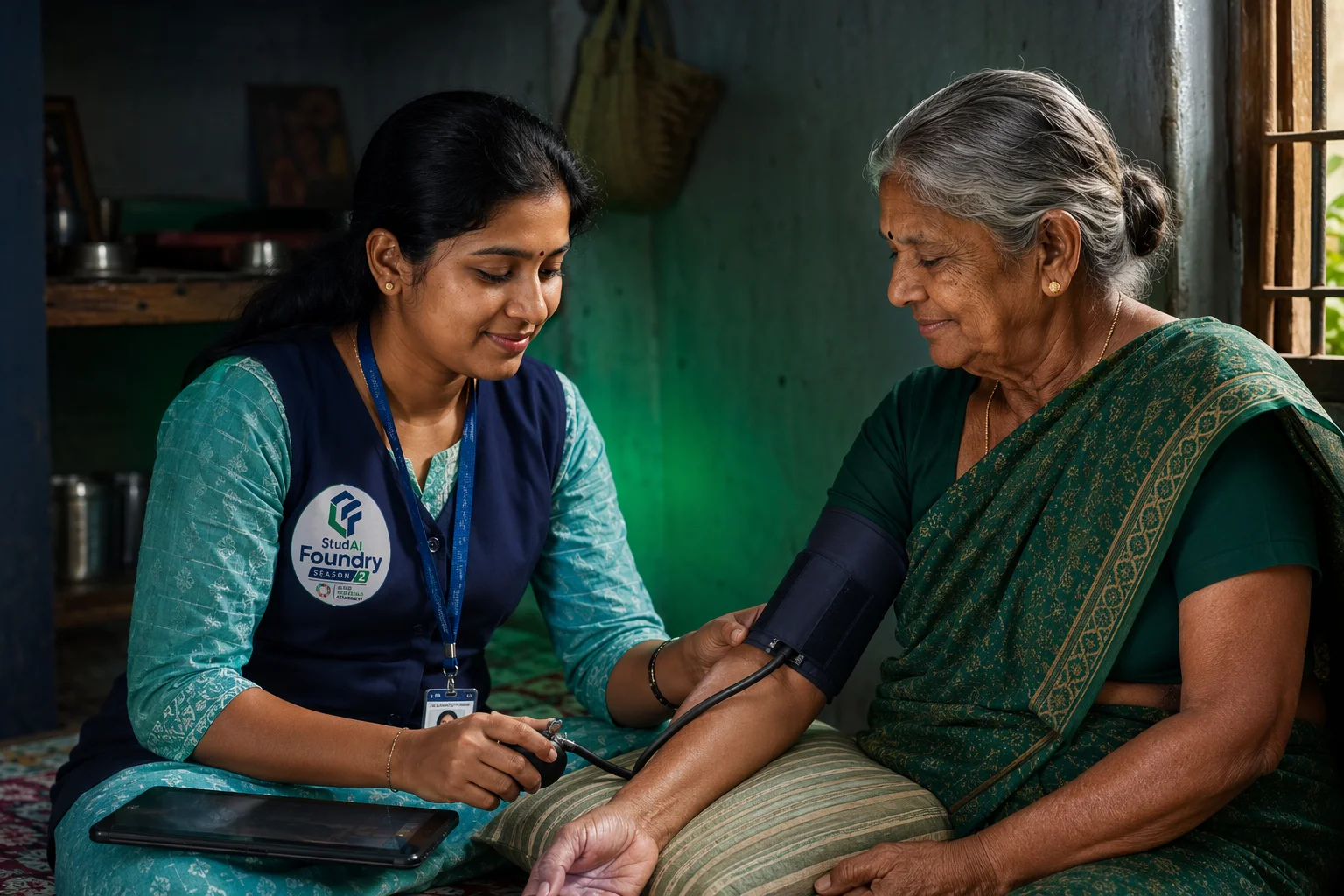
A community health worker recording a home-visit measurement for an elderly patient.

Why this goal matters

The scarcest resource in healthcare is qualified human attention. Patients wait, frontline workers are overloaded, and preventable conditions are caught late. Software that triages, reminds, translates and organises can return hours of clinical time to the people who need it — if it is built with humility about what it must not decide.

The Indian context

India’s health system spans world-class tertiary hospitals and severely stretched primary care. ASHA and anganwadi workers carry enormous community-health responsibility with paper-heavy workflows. Digital health infrastructure (ABDM) is emerging, but the everyday gaps are practical: missed follow-ups, unclear referrals, medication confusion and unaddressed mental health.

Tamil Nadu, specifically

Tamil Nadu consistently ranks among India’s stronger public-health states, with an extensive primary-health-centre network. That strength makes it a good pilot ground: workflows exist and can be improved, rather than invented. Urban Chennai adds a different problem set — elder care, lifestyle-disease follow-up and mental-health stigma among students.

People and communities affected

  • Patients in rural areas far from specialists
  • Community health workers managing hundreds of households
  • Elderly people managing multiple medications alone
  • Students and young professionals facing mental-health pressure
  • Caregivers of chronic-condition patients

Key challenge areas

  • Screening-camp and follow-up organisation
  • Medication adherence and elder support
  • Mental-health first support and safe escalation
  • Frontline-worker workflow digitisation
  • Health-information translation and simplification

The AI Lens

Where AI belongs here — and where it does not.

Where AI can meaningfully help

  • Triage assistance that helps a health worker prioritise visits — with the worker deciding
  • Explaining prescriptions and discharge instructions in plain Tamil
  • Listening-first mental-health support that recognises risk and hands over to humans
  • Turning paper registers into structured data through document understanding

Where AI may be inappropriate

  • Diagnosis or treatment decisions presented as final — clinical judgement is non-delegable
  • Mental-health chatbots that simulate therapy without crisis-escalation design
  • Predicting individual disease risk from data users never consented to share

Build Directions

Example problem directions

Starting points, not prescriptions — the strongest submissions narrow one of these into a specific, evidenced local problem.

Direction 01

A follow-up companion for screening camps: who was flagged, who returned, who is being missed

Direction 02

A medication assistant for elders: photograph the strip, get schedule, interactions to ask a pharmacist about, and reminders

Direction 03

A frontline-worker assistant that converts a home visit conversation into the required register entries

Direction 04

A campus mental-health bridge: anonymous first support, mood patterns owned by the user, warm handover to counsellors

Potential users

  • Primary-health-centre staff and ASHA workers
  • Patients and family caregivers
  • College counselling cells
  • NGO health programmes

Possible datasets

  • Published clinical guidelines and government health protocols
  • Open medical NLP corpora for fine-tuning language understanding
  • Aggregate NFHS and HMIS indicators (public)
  • Consented pilot data collected with your partner organisation

Data-access limitations

  • Real patient records are strictly protected — never train on scraped or leaked clinical data
  • Open datasets are mostly English and Western-population based; local validity must be checked
  • Small consented pilots mean small data — design methods that work with little data

Privacy, bias and safety risks

  • A confident wrong answer in health is dangerous; uncertainty must be visible
  • Escalation failure in mental-health tools can cost lives — crisis paths are mandatory, not optional
  • Health data leaks cause lasting harm; security is part of the build, not a later step

Responsible-AI considerations

  • State clearly, in-product, what the tool is not (not a doctor, not therapy)
  • Build and test the human-escalation path before any other feature
  • Minimise stored health data; encrypt what must exist
  • Review outputs with a qualified clinician before your Lock 3 demo

Suggested impact metrics

  • Follow-up completion rate in a pilot cohort, before versus after
  • Time saved per frontline worker per day, measured not estimated
  • Escalation-path reliability: percentage of risk cases correctly handed to a human

Build for Good Health and Well-being.

Anchor your team in this goal, define one real problem, and start the three-lock journey.

Register Your Team