Season 2 registrations are open — Chennai · 28 August 2026 and Coimbatore · 25 September 2026.

Register Your Team

Sustainable Development Goal 04 / 17

Quality Education

Ensure inclusive, equitable quality education and lifelong learning for all. For builders: tools that help under-resourced classrooms, first-generation learners and teachers — not tools that replace them.
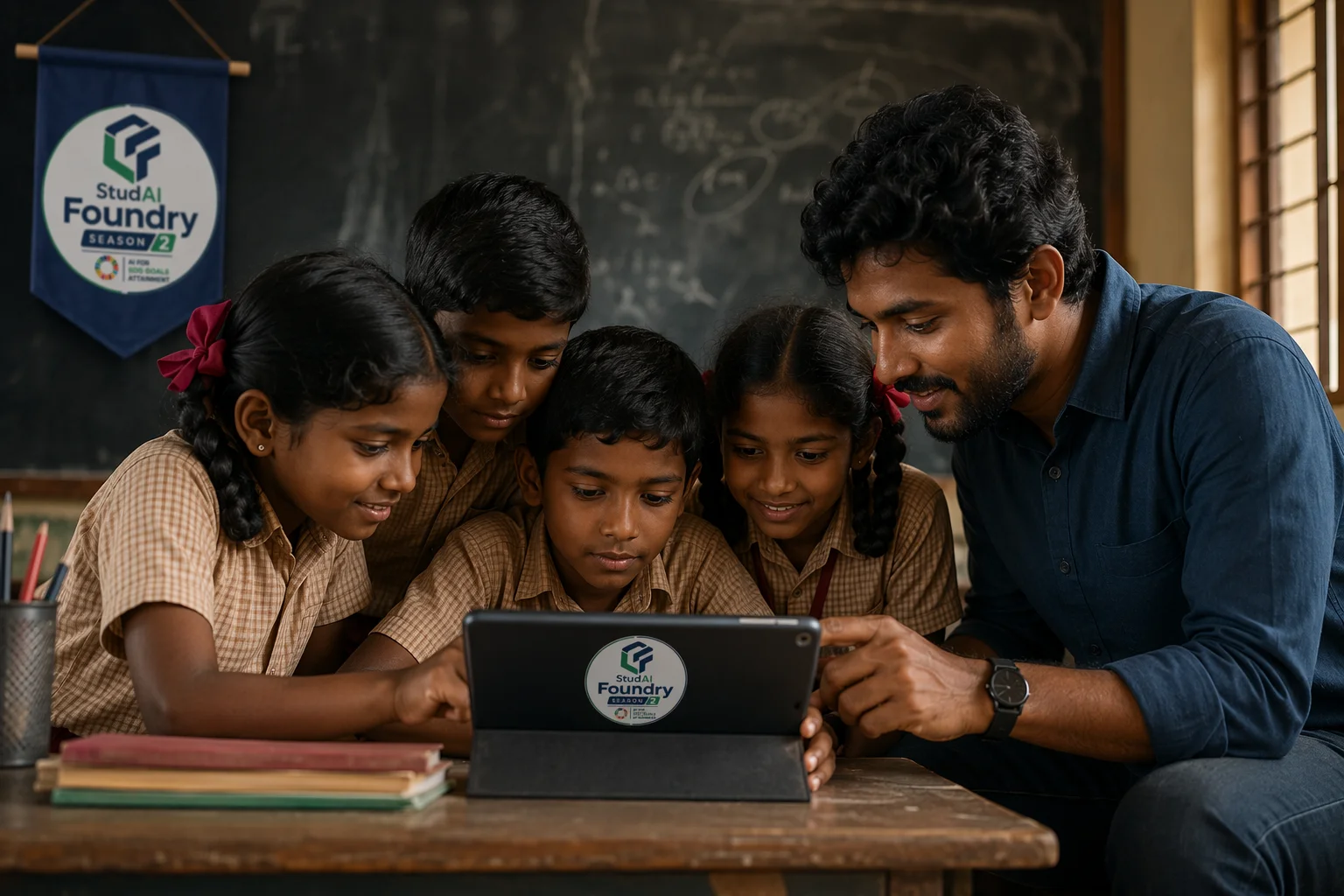
Children gathered around a shared tablet with a teacher guiding, in a modest classroom.

Why this goal matters

Learning gaps compound. A student who falls behind in foundational reading or arithmetic experiences every later class as noise. Teachers in large, mixed-level classrooms know this but lack the time to individualise. Technology that meets each learner at their actual level, in their own language, changes trajectories.

The Indian context

India has near-universal enrolment but persistent learning-outcome challenges, documented year after year in national surveys. Classrooms are multilingual and multi-level; teacher time is consumed by administration; and first-generation learners lack anyone at home who can help with schoolwork. English-medium aspiration collides with mother-tongue comprehension.

Tamil Nadu, specifically

Tamil Nadu invests heavily in school education and runs one of India’s larger higher-education systems. Practical gaps remain: rural students preparing for competitive exams without coaching access, arts and science students needing employability skills, and Tamil-medium learners hitting an English wall in technical education.

People and communities affected

  • Students in government and low-fee private schools
  • First-generation college students
  • Teachers in large mixed-ability classrooms
  • Learners with visual, hearing or learning disabilities
  • Adults seeking second-chance education and reskilling

Key challenge areas

  • Foundational literacy and numeracy support
  • Personalised practice at the learner’s real level
  • Teacher preparation and workload reduction
  • Accessible learning for disabled students
  • Mother-tongue to English bridging in technical subjects

The AI Lens

Where AI belongs here — and where it does not.

Where AI can meaningfully help

  • Adaptive practice that diagnoses the actual gap, not the syllabus position
  • Generating differentiated worksheets and explanations for one classroom’s spread of levels
  • Reading assistants that listen, correct gently and track fluency growth
  • Translating and simplifying technical content into Tamil without losing precision

Where AI may be inappropriate

  • Grading high-stakes exams without human review
  • Surveillance-style attention tracking of students
  • Replacing teacher judgement about a child’s progress or wellbeing

Build Directions

Example problem directions

Starting points, not prescriptions — the strongest submissions narrow one of these into a specific, evidenced local problem.

Direction 01

A foundational-numeracy companion that adapts in Tamil and English and works on a shared family phone

Direction 02

A teacher assistant that turns one lesson plan into three difficulty levels plus a quick diagnostic

Direction 03

An accessible-study tool converting textbook pages into structured audio with navigable headings

Direction 04

A doubt-solver for first-generation engineering students that explains in the student’s stronger language first

Potential users

  • School and college students
  • Teachers and teacher-training institutes
  • Parents supporting young learners
  • Skill-development programmes

Possible datasets

  • NCERT and state-board open textbooks and syllabi
  • DIKSHA open educational resources
  • ASER and UDISE+ aggregate indicators (public)
  • Your own pilot assessments, with school and parental consent

Data-access limitations

  • Children’s data carries the highest protection bar — collect the absolute minimum with guardian consent
  • Open content skews English; Tamil technical corpora are thinner
  • Learning-outcome claims need controlled comparison, not testimonials

Privacy, bias and safety risks

  • Hallucinated explanations teach errors confidently — factual grounding is essential
  • Over-gamification optimises engagement, not learning
  • Tools tuned on urban data can misjudge rural learners’ starting points

Responsible-AI considerations

  • Ground generated explanations in the actual textbook content
  • Design guardian-consent and data-minimisation for minors from the start
  • Measure learning, not screen time
  • Keep the teacher in control of anything that reaches the classroom

Suggested impact metrics

  • Pre/post learning-gain on a defined skill in a pilot group
  • Teacher preparation time saved per week, measured
  • Accessibility conformance of produced study materials

Build for Quality Education.

Anchor your team in this goal, define one real problem, and start the three-lock journey.

Register Your Team