Season 2 registrations are open — Chennai · 28 August 2026 and Coimbatore · 25 September 2026.

Register Your Team

Sustainable Development Goal 02 / 17

Zero Hunger

End hunger, achieve food security, improve nutrition and promote sustainable agriculture. For builders: tools that help farmers grow more predictably and help food reach people before it is wasted.
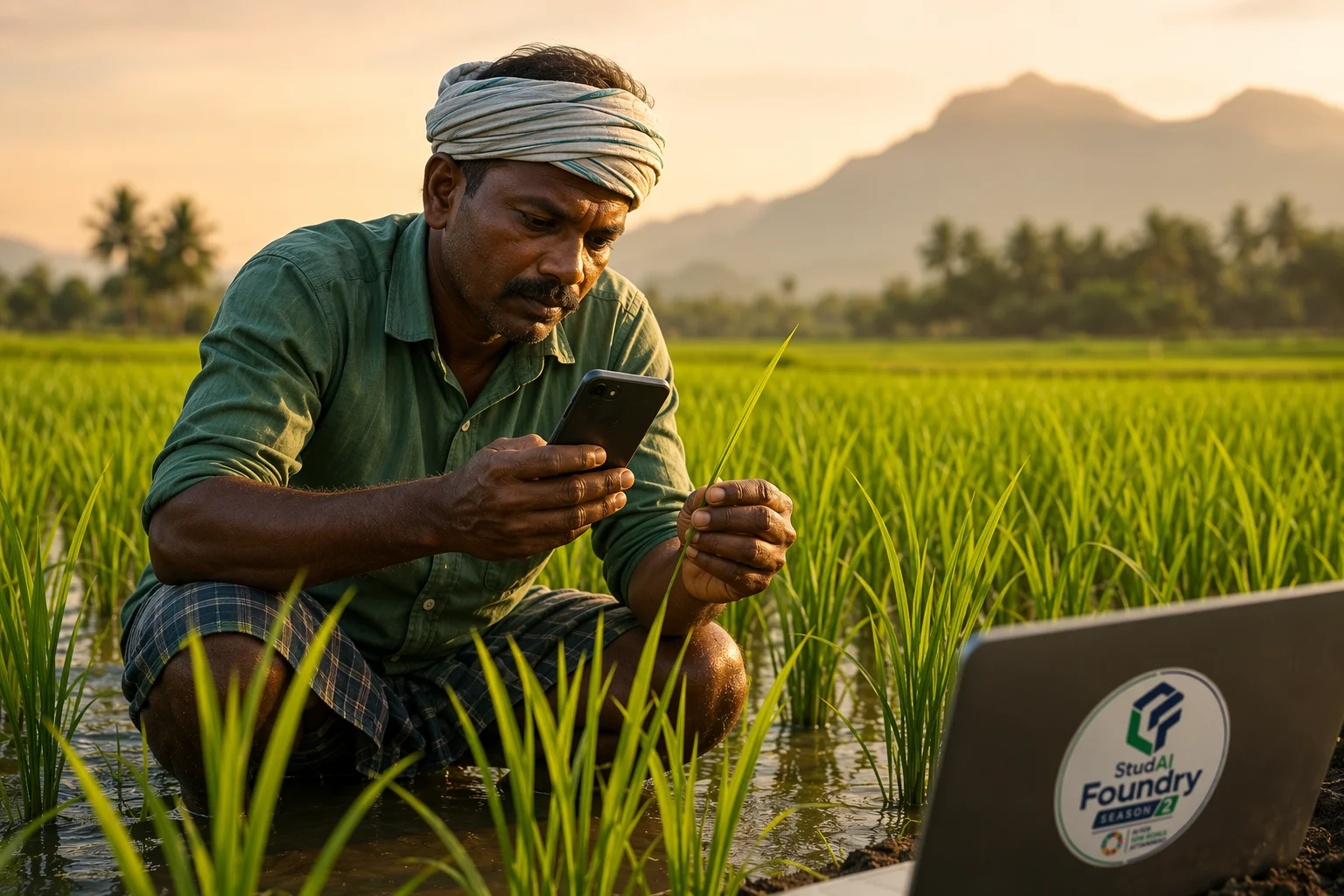
A farmer inspecting young paddy while checking guidance on a phone.

Why this goal matters

Hunger today is mostly a systems failure, not a production failure. Food is grown, then lost in storage and transport; farmers plant without reliable signals about weather, pests or prices; nutrition programmes struggle to identify who is slipping through. Each of these is an information problem software can genuinely improve.

The Indian context

India is one of the world’s largest food producers and simultaneously home to widespread undernutrition, especially among children and mothers. Smallholder farmers — the majority of Indian agriculture — work with thin margins where a single bad decision on crop choice, irrigation or sale timing hurts a whole season.

Tamil Nadu, specifically

Tamil Nadu combines intensive delta rice farming, dryland agriculture and strong horticulture belts around Coimbatore. Farmers face water stress in the Cauvery basin, pest pressure that shifts with the climate, and price volatility at regulated markets. The state’s noon-meal heritage also makes institutional nutrition delivery a natural problem space.

People and communities affected

  • Smallholder and tenant farmers
  • Agricultural labourers paid by the day
  • Children and mothers in nutrition-vulnerable households
  • Fishing and pastoral communities with seasonal income
  • Urban poor dependent on subsidised food access

Key challenge areas

  • Crop-health monitoring and pest early warning
  • Yield and irrigation planning under water stress
  • Post-harvest loss and cold-chain gaps
  • Market-price transparency for small sellers
  • Nutrition-programme targeting and follow-up

The AI Lens

Where AI belongs here — and where it does not.

Where AI can meaningfully help

  • Image-based crop disease and pest identification from a phone camera
  • Local-language advisory that fuses weather, soil and crop-stage information
  • Demand and price forecasting to guide what to plant and when to sell
  • Routing surplus food from events and retailers to verified community kitchens

Where AI may be inappropriate

  • Replacing agronomists for high-stakes decisions like pesticide dosing without expert validation
  • Predicting individual household hunger in ways that label or shame families
  • Automated commodity speculation tools that worsen price volatility for farmers

Build Directions

Example problem directions

Starting points, not prescriptions — the strongest submissions narrow one of these into a specific, evidenced local problem.

Direction 01

A Tamil-first crop-clinic assistant: photograph a leaf, get a verified diagnosis pathway and safe next steps

Direction 02

A mandi price companion that helps a farmer decide sell-now versus store-and-wait with honest uncertainty

Direction 03

A food-rescue coordinator matching surplus from hostels and halls to nearby feeding programmes

Direction 04

An anganwadi assistant that helps workers track growth measurements and flag follow-ups

Potential users

  • Smallholder farmers and farmer-producer organisations
  • Agricultural extension officers
  • Anganwadi and nutrition workers
  • Food-rescue NGOs and community kitchens

Possible datasets

  • IMD weather data and Agmarknet mandi prices (public)
  • Open plant-disease image datasets (e.g. research corpora) for transfer learning
  • ICRISAT and state agriculture department advisories (published)
  • Your own field photos and farmer interviews, with consent

Data-access limitations

  • Public disease image datasets rarely match local crop varieties and lighting — expect a domain gap
  • Mandi price feeds lag and miss informal trade
  • Nutrition data at individual level is protected; work with aggregates or consented pilots

Privacy, bias and safety risks

  • A wrong diagnosis can destroy a season — always show confidence and a human-expert pathway
  • Advisories that ignore water-availability reality can increase farmer debt
  • Camera-based tools can fail exactly in the low-end-device conditions where they are needed most

Responsible-AI considerations

  • Validate against expert-labelled local samples before any accuracy claim
  • Design for offline and low-bandwidth use
  • Never present a probabilistic guess as a certain instruction
  • Keep farmer data owned by the farmer

Suggested impact metrics

  • Diagnosis accuracy versus expert labels on a held-out local test set
  • Measured reduction in crop-loss incidents among pilot users
  • Kilograms of surplus food successfully redirected in a pilot period

Build for Zero Hunger.

Anchor your team in this goal, define one real problem, and start the three-lock journey.

Register Your Team