Season 2 registrations are open — Chennai · 28 August 2026 and Coimbatore · 25 September 2026.

Register Your Team

Sustainable Development Goal 07 / 17

Affordable and Clean Energy

Ensure access to affordable, reliable, sustainable and modern energy for all. For builders: tools that help households, institutions and small industries consume smarter and adopt clean energy with confidence.
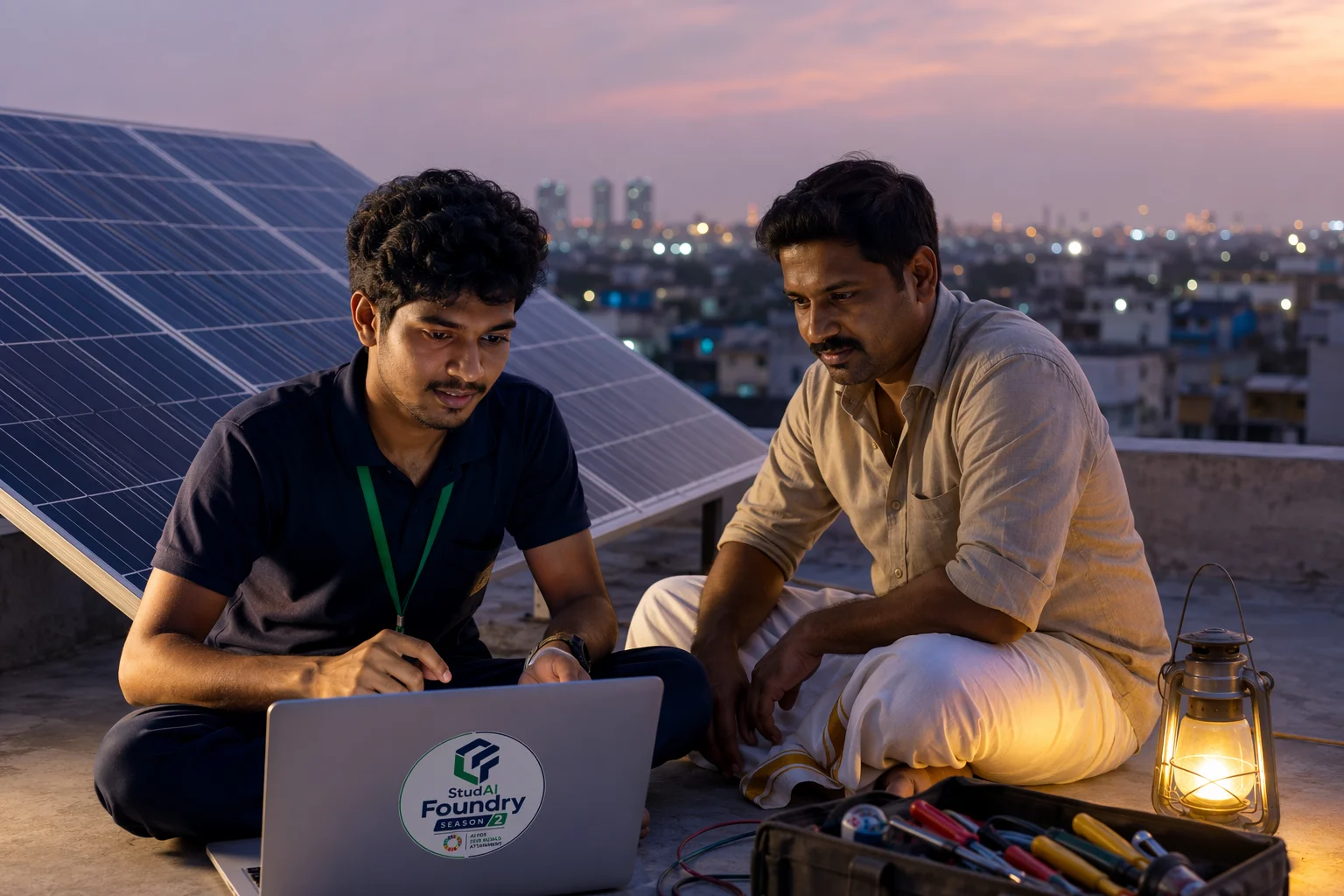
A technician and homeowner reviewing rooftop solar panels at dusk.

Why this goal matters

The energy transition is decided in millions of small decisions: whether a family trusts rooftop solar, whether a small factory can see which machine wastes power, whether a village microgrid stays maintained. Software that turns invisible energy flows into understandable decisions accelerates all of it.

The Indian context

India is simultaneously one of the world’s largest renewable-energy builders and a country where electricity reliability still varies widely. Rooftop-solar policy support exists but adoption is slowed by trust, sizing confusion and paperwork. Small and medium industries — a huge share of national consumption — rarely have energy-analytics access that large factories take for granted.

Tamil Nadu, specifically

Tamil Nadu is an Indian wind-power pioneer — the Muppandal belt near the southern tip is among Asia’s largest wind concentrations — and a major solar state. Coimbatore’s pump, motor and textile industries make industrial energy efficiency a natural local problem; Chennai’s apartment towers make rooftop-solar decision tools immediately useful.

People and communities affected

  • Households facing rising tariffs with no usage visibility
  • Small industries with energy-hungry legacy equipment
  • Farmers running irrigation pumps on subsidised power
  • Apartment associations weighing solar investments
  • Off-grid and unreliable-grid rural communities

Key challenge areas

  • Consumption visibility and waste detection
  • Rooftop-solar decision support and sizing
  • SME energy-efficiency analytics
  • Renewable-asset maintenance prediction
  • Demand planning for local grids

The AI Lens

Where AI belongs here — and where it does not.

Where AI can meaningfully help

  • Disaggregating a building’s load to show which equipment consumes what
  • Solar-yield estimation from roof geometry, shading and local weather history
  • Predictive maintenance signals for wind and solar assets from sensor patterns
  • Tariff-aware scheduling suggestions for flexible industrial loads

Where AI may be inappropriate

  • Guaranteeing financial returns on energy investments — models inform, they do not promise
  • Automated control of safety-critical electrical equipment without certified engineering
  • Punitive consumption profiling of low-income households

Build Directions

Example problem directions

Starting points, not prescriptions — the strongest submissions narrow one of these into a specific, evidenced local problem.

Direction 01

A rooftop-solar advisor for Chennai apartments: photos plus bill history in, honest sizing and payback ranges out

Direction 02

An SME energy copilot that finds the three cheapest fixes from a month of smart-meter data

Direction 03

A pump-efficiency assistant for farm clusters comparing similar pumps to spot degradation

Direction 04

A hostel or campus energy dashboard that turns consumption into weekly actions

Potential users

  • Households and apartment associations
  • SME owners and energy auditors
  • Renewable-asset operators
  • Campus facility teams

Possible datasets

  • Your own metered pilot data (smart plugs, meters) with consent
  • NREL/NASA solar irradiance datasets (public)
  • CEA and TANGEDCO published generation and tariff information
  • Open building-load research datasets for pre-training

Data-access limitations

  • Indian appliance-level load signatures differ from Western research datasets
  • Utility meter data access requires the customer’s own download or consent
  • Weather-to-yield models need local calibration to be honest

Privacy, bias and safety risks

  • Over-promised savings destroy trust in the whole category
  • Electrical-safety advice must defer to qualified electricians
  • Optimisation that ignores comfort or production reality gets uninstalled

Responsible-AI considerations

  • Present estimates as ranges with assumptions visible
  • Keep humans in the loop for any physical control action
  • Make the baseline measurable before claiming improvement

Suggested impact metrics

  • Measured kWh reduction against a defined baseline in the pilot
  • Estimate accuracy: predicted versus actual solar yield or savings
  • Payback-model transparency: every assumption inspectable

Build for Affordable and Clean Energy.

Anchor your team in this goal, define one real problem, and start the three-lock journey.

Register Your Team