
Season 2 registrations are open — Chennai · 28 August 2026 and Coimbatore · 25 September 2026.

Register Your Team

Sustainable Development Goal 09 / 17

Industry, Innovation and Infrastructure

Build resilient infrastructure, promote inclusive and sustainable industrialisation and foster innovation. For builders: tools that modernise MSMEs, maintain public infrastructure and democratise industrial intelligence.
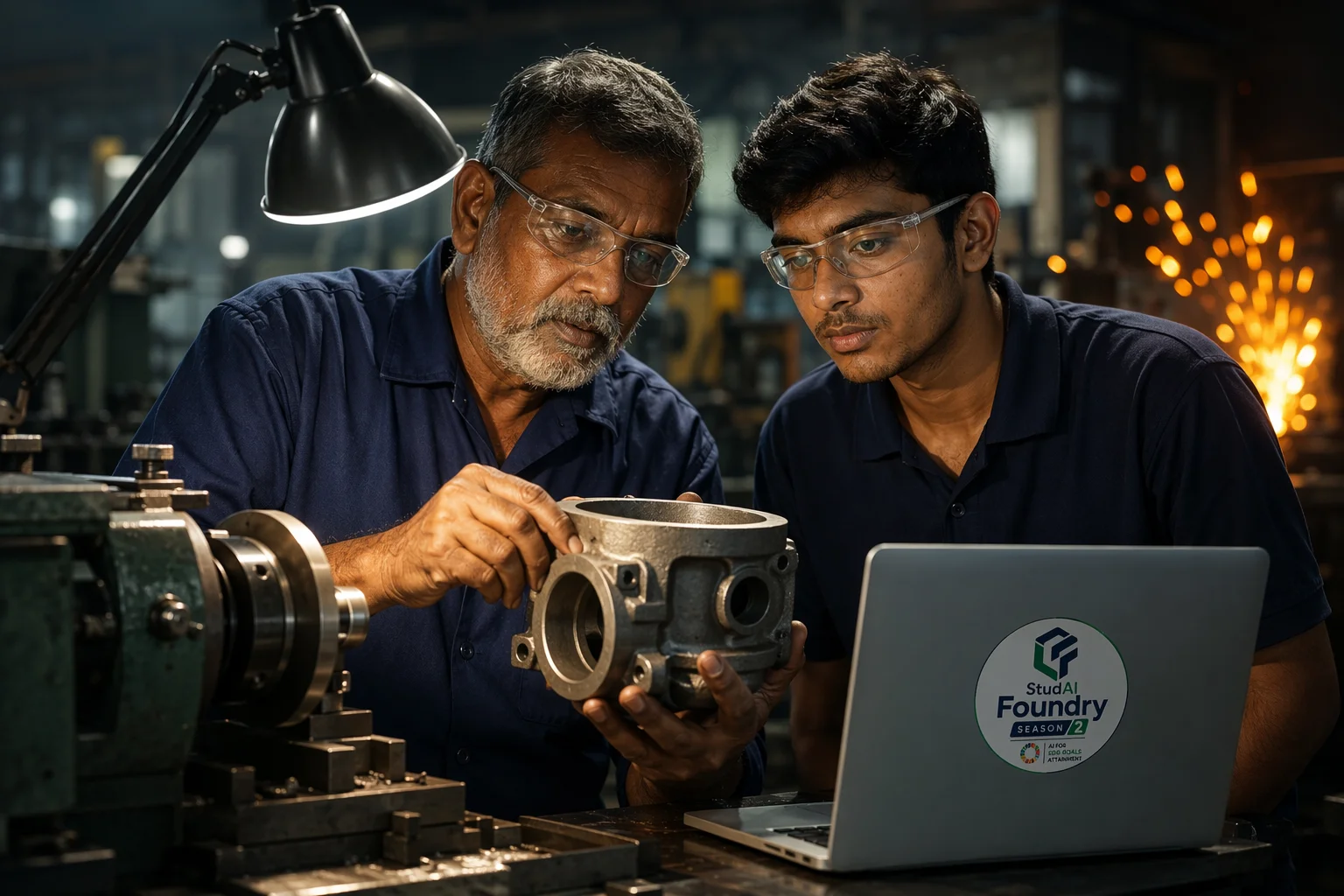
A machinist and an engineering student inspecting a cast part together in a small workshop.

Why this goal matters

The technology gap inside economies is wider than the gap between them. A large factory has sensors, dashboards and planners; the workshop across the road runs on memory and paper. Public infrastructure — roads, bridges, buses — decays quietly until failure. Software that brings industrial-grade intelligence to small operators and public assets multiplies productivity where it matters most.

The Indian context

MSMEs contribute a huge share of India’s manufacturing output and employment yet remain the least digitised layer of the economy. National infrastructure investment is at record levels, which makes maintenance intelligence — knowing what is degrading where — an increasingly valuable public capability.

Tamil Nadu, specifically

Coimbatore is one of India’s great MSME cities: pumps, motors, foundries, machining shops — often family-run, deeply skilled and minimally digitised. Chennai anchors automotive and electronics manufacturing corridors. Between them sits a living laboratory for shop-floor AI that respects how small industry actually works.

People and communities affected

  • MSME owners and shop-floor workers
  • Commuters dependent on ageing public transport
  • Residents affected by infrastructure failures
  • Industrial-cluster job seekers
  • Local bodies maintaining civic assets

Key challenge areas

  • Shop-floor digitisation without disruption
  • Predictive quality and maintenance for small factories
  • Public-asset condition monitoring
  • Supply-chain visibility for clusters
  • Skilled-trade knowledge preservation

The AI Lens

Where AI belongs here — and where it does not.

Where AI can meaningfully help

  • Detecting quality defects from phone-camera images at a fraction of machine-vision-system cost
  • Predicting machine failures from vibration and sound patterns on affordable sensors
  • Reading handwritten job cards and registers into structured production data
  • Prioritising road or asset repairs from citizen photo reports and inspection history

Where AI may be inappropriate

  • Fully autonomous control of dangerous machinery without certified safety engineering
  • Worker-replacement framing in communities where the promise should be augmentation
  • Infrastructure-risk scoring published without engineering validation — panic has costs

Build Directions

Example problem directions

Starting points, not prescriptions — the strongest submissions narrow one of these into a specific, evidenced local problem.

Direction 01

A casting-defect spotter for foundries: photograph parts, learn the shop’s specific defect patterns, catch drift early

Direction 02

A machine-health listener that learns each machine’s normal sound and flags deviation

Direction 03

A pothole-and-asset reporter that deduplicates citizen photos and builds repair-priority maps

Direction 04

A digital job-card system that speaks the shop floor’s language, literally

Potential users

  • MSME owners and cluster associations
  • Maintenance technicians
  • Municipal engineering departments
  • Industrial-training institutes

Possible datasets

  • Open industrial defect and machinery-sound research datasets for pre-training
  • Your partner workshop’s own images and readings, with consent
  • Municipal complaint and works data where published
  • MSME ministry cluster statistics (public, aggregate)

Data-access limitations

  • Every shop’s defects and machines differ — plan for per-site fine-tuning
  • Industrial data is commercially sensitive; agreements matter
  • Public asset data is fragmented across departments

Privacy, bias and safety risks

  • A missed defect that ships erodes trust instantly — set thresholds honestly
  • Sensor projects die without maintenance plans
  • Digitisation that adds work for the shop floor gets abandoned

Responsible-AI considerations

  • Fit the tool to existing workflows; do not demand new ones
  • Keep the shop’s data the shop’s property
  • State detection limits explicitly; never imply certified inspection

Suggested impact metrics

  • Defect-catch rate versus current practice in a pilot line
  • Downtime avoided through early warnings, measured against history
  • Paper-to-digital time savings per job card

Build for Industry, Innovation and Infrastructure.

Anchor your team in this goal, define one real problem, and start the three-lock journey.

Register Your Team