Season 2 registrations are open — Chennai · 28 August 2026 and Coimbatore · 25 September 2026.

Register Your Team

Sustainable Development Goal 13 / 17

Climate Action

Take urgent action to combat climate change and its impacts. For builders: tools that turn climate risk into local, timely, actionable information for the people who bear it first.
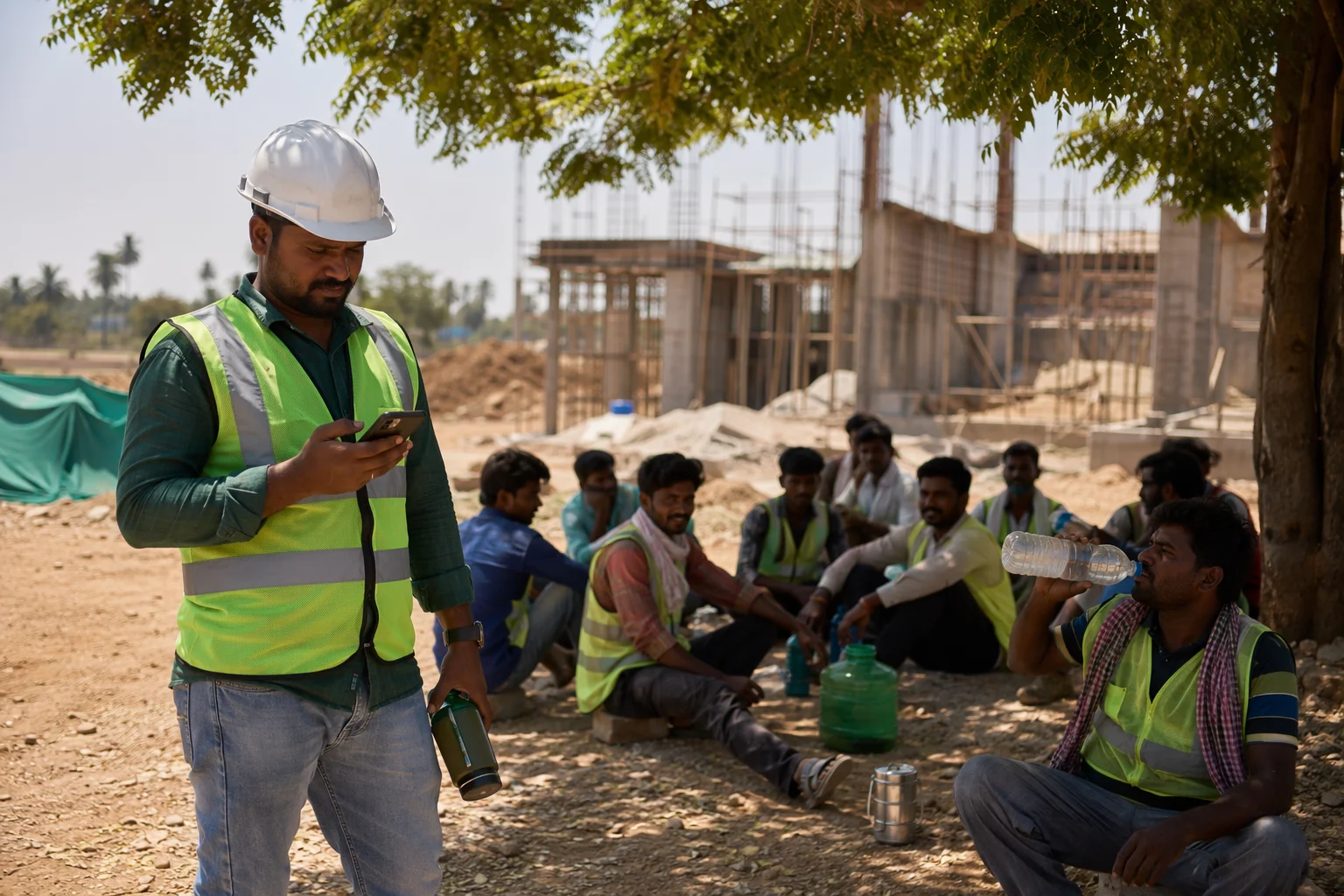
A worksite supervisor checking a heat-alert on his phone while his crew rests in shade.

Why this goal matters

Climate change arrives as weather: a cyclone with a name, a heatwave without one, rain that skips a season then falls in a week. Global models exist; what is missing is the last mile — translating planetary signals into what a farmer, a fisher, a ward officer or a school should do this week. That translation layer is software.

The Indian context

India faces intensifying heatwaves, erratic monsoons, coastal exposure and glacier-fed river stress simultaneously. National adaptation programmes and early-warning systems have improved measurably — cyclone mortality has fallen dramatically over two decades — but heat action plans, urban flood response and farm-level advisories still reach far fewer people than they should.

Tamil Nadu, specifically

Tamil Nadu’s 1,000-kilometre coastline faces cyclones and sea-level stress; Chennai alternates between flood and drought; interior districts face heat and water variability that strain both farms and industry. The state publishes climate-action plans and district vulnerability data — raw material for builders who make it usable.

People and communities affected

  • Coastal fishing communities
  • Outdoor workers exposed to extreme heat
  • Rain-dependent farming households
  • Flood-prone urban neighbourhoods
  • Children and elderly people during heat events

Key challenge areas

  • Heat-risk early warning and response
  • Hyper-local flood and cyclone communication
  • Climate-adaptive farm advisories
  • Community resilience planning
  • Climate-data translation for local government

The AI Lens

Where AI belongs here — and where it does not.

Where AI can meaningfully help

  • Downscaling forecasts into street- and village-level guidance in local languages
  • Heat-stress alerts tuned to occupation — construction, delivery, farming — not just temperature
  • Fusing satellite, terrain and report data for flood nowcasting
  • Summarising climate assessments into ward-level action checklists

Where AI may be inappropriate

  • Long-range climate prediction beyond established science — do not out-model the IPCC
  • Fatalistic risk messaging without actionable guidance
  • Carbon-offset scoring without verifiable measurement

Build Directions

Example problem directions

Starting points, not prescriptions — the strongest submissions narrow one of these into a specific, evidenced local problem.

Direction 01

A heat companion for outdoor-work supervisors: hourly risk, mandated-break suggestions and symptom triage grounded in heat-action-plan protocols

Direction 02

A fisher’s weather bridge: sea-condition forecasts, warning translation and return-window guidance in Tamil, offline-tolerant

Direction 03

A school climate-drill assistant that localises cyclone and flood preparedness to each campus

Direction 04

A district adaptation dashboard turning published vulnerability data into ranked local actions

Potential users

  • Coastal and farming communities
  • Worksite supervisors and unions
  • District disaster-management authorities
  • Schools and local bodies

Possible datasets

  • IMD forecasts, warnings and historical weather (public)
  • INCOIS ocean-state and fishing-advisory services (public)
  • ISRO/Bhuvan and open satellite imagery
  • State climate-action plans and district vulnerability assessments (published)

Data-access limitations

  • Forecast skill drops sharply at hyper-local scales — communicate uncertainty honestly
  • Historical station data has gaps; satellite proxies need validation
  • Vulnerability indices aggregate away the street-level differences that matter

Privacy, bias and safety risks

  • Missed warnings and false alarms both cost lives and trust — precision-recall trade-offs are ethical decisions here
  • Alert fatigue is real; frequency design matters as much as accuracy
  • Climate tools that require constant connectivity fail during the disasters they exist for

Responsible-AI considerations

  • Defer to official warnings; add localisation and reach, never contradiction
  • Design offline-first for disaster conditions
  • Test message comprehension with actual users before the season

Suggested impact metrics

  • Warning reach and comprehension in pilot communities
  • Lead time delivered versus baseline channels
  • Documented protective actions taken following alerts

Build for Climate Action.

Anchor your team in this goal, define one real problem, and start the three-lock journey.

Register Your Team